

Table of Contents
ToggleNatural vs Synthetic Perfume: What Labels Won’t Tell You
You’ve decluttered your bathroom, spotted questionable ingredients in your foundation, and convinced your family to embrace healthier consumption habits. One last fortress often remains: your favorite perfume.
Switching to a healthier, more environmentally friendly fragrance seems like the final step in your cosmetic transition. But in the hushed world of perfumery, marketing reigns supreme and opacity rules. Before being seduced by a designer bottle or promises of an “enchanting sillage,” it’s time to examine labels closely and understand what truly hides behind the word “Perfume,” analyzing the critical differences between natural vs synthetic perfume ingredients.
A “classical perfume”, what’s that again ?
Conventional Perfume: A Petrochemical Cocktail
Opposite to natural perfumes, conventional fragrances are often complex chemical cocktails. Far from simple petal distillation, these formulas rely on numerous synthetic ingredients derived from petrochemicals, frequently mixed with natural substances.
A typical conventional perfume composition includes:
- Denatured Alcohol: The base solvent. In conventional perfumes, denaturation often uses chemical agents like phthalates in perfume (e.g., Diethyl Phthalate), which are endocrine disruptors not always explicitly listed on the INCI label.
- Perfume” or “Fragrance”: This generic, catch-all term is perfect camouflage. It can hide hundreds of undisclosed synthetic substances.
- Phthalates: Used as fixatives to prolong fragrance longevity, some are classified as endocrine disruptors.
Other problematic ingredients, include
- Synthetic Musks: Persistent molecules (Galaxolide, Cashmeran) suspected of being carcinogenic and harmful to aquatic life. These synthetic musks endocrine disruptors accumulate in the body.
- UV Filters : Such as Ethylhexyl Methoxycinnamate, added to protect liquid color in clear glass bottles. Once inhaled, they act as endocrine disruptors.
Natural or Certified Organic Perfume: Transparency First
A truly natural or organic perfume breaks from synthetic chemistry. It is crafted exclusively from naturally derived ingredients, without adding controversial substances. The goal? Create an authentic olfactory experience respectful of your skin, health, and the planet.
What you’ll truly find in a natural/organic perfume bottle:
Essential Oils and Absolutes: Obtained through steam distillation, cold expression, or CO2 extraction.
Plant Extracts: Flowers (jasmine, almond blossom), fruits (bergamot, clementine), spices (cinnamon, pepper).
Organic Alcohol: Generally derived from cereal fermentation (like wheat), denatured with essential oils, avoiding toxic denatured alcohol in cosmetics agents.
Green Biotechnology Fragrance Molecules: Natural alternatives created through fermentation, without petroleum.
These ingredients often come from organic agriculture, guaranteeing absence of pesticides and GMOs. This ensures total transparency, whereas conventional perfumery cultivates secrecy. Look for reliable organic cosmetic labels like Cosmos Organic, Natrue, USDA Organic or Ecocert to verify these claims.
The Fully Assumed Limits of 100% Natural
Let’s be honest: renouncing synthetic substances sometimes means making choices, entirely relevant ones. Organic perfumes cannot (and don’t want to) copy everything.
Goodbye Marine Notes: Impossible to obtain naturally without synthetic molecules.
Goodbye Real Animal Musk: Fortunately banned to protect species, replaced in organic perfumes by vegetal or biotechnological alternatives, less heady but healthier.
Different Longevity: A natural perfume evolves on your skin more subtly, far from the artificial, tenacious sillage of petrochemical fixatives. It may seem more “volatile” than its chemical cousin.
Honestly, this is a real asset.
Who hasn’t found themselves trapped on a 6-hour train next to someone who overused their favorite aftershave that morning? A true nightmare. A more natural perfume lasts less time compared to its conventional counterpart… and that’s a good thing.
The Synthetic Revolution: When Chemistry Imitates (and Surpasses) Nature
Until the 19th century, perfumery was exclusively natural: capturing scents from flowers, aromatics, and resins in bottles. Synthetic chemistry changed everything. Today, almost all perfumes, even from luxury houses, are hybrids: a hint of natural ingredients for marketing, and a massive base of synthetic molecules for the rest.
Why? Because synthesis allows reproducing everything, even creating scents that don’t exist in nature. It also drastically reduces production costs faced with the rarity and exorbitant price of certain natural raw materials.
Manufacturing Process: From Traditional Distillation to Petrochemistry
Several methods exist to capture a scent. The difference is significant:
1. Distillation: The ancestral method. Steam passes through plants to extract essential oil. Pure and natural.
2. Solvent Extraction: Vegetables macerate in a solvent which is then evaporated. Obtaining a “concrete” then an “absolute.”
3. Enfleurage: A rare, costly technique where flowers macerate in fatty substances. Almost disappeared.
4. Synthesization: The flagship method of modern industry. It allows reproducing scents (or inventing new ones) from petroleum derivatives. Here lies the problem: maximum economic and olfactory efficiency, but heavy health and environmental impact.
Still Too Many Problematic Substances in Conventional Perfumes
Certain hidden substances under the “Perfume” label pose real public health issues. Of course, as always with controversial components, these substances are authorized by European and international regulations and public health codes. But everything “authorized” isn’t necessarily risk-free, as numerous restrictions or bans on chemical substances show, often occurring after decades of scientific proof and endless regulatory steps.
The CHEMTRUST Study CHEMTRUST: One Among Many Findings
In June 2022, CHEMTRUST analyzed 20 perfumes from major brands (Paco Rabanne, Chanel, Dior, Yves Saint Laurent, etc.) purchased across Europe. The verdict is clear: these fragrances contain endocrine disruptors, reprotoxic substances, masked allergens, and polluting ingredients.
Among culprits regularly highlighted by magazines like Germany’s Öko-Test:
- Polycyclic Musks (Galaxolide, Cashmeran): Persistent in organisms and environment, suspected carcinogens.
- Lilial (Butylphenyl Methylpropional): Banned since 2022 in the EU for reproductive toxicity, but still present in some stocks or non-EU products.
- Certain UV Filters – sunscreens (Ethylhexyl Methoxycinnamate, Octocrylene): Added to protect perfume color, they act as endocrine disruptors once inhaled.

Alcohol: Low Risk for Formulation, But What About Denaturation?
Cosmetic alcohol must be rendered unfit for human consumption through a denaturation process validated by customs, avoiding consumption and special taxes. This denaturation uses natural substances like essential oils (lavender, rosemary), artificial perfumes, or purely chemical substances.
In Europe, labeling indicates either “ALCOHOL DENAT.” for already denatured alcohol, or “ALCOHOL” with the denaturant name, or simply “ALCOHOL” if denaturation occurs in-situ within the formula.
Pure alcohol used in cosmetics is mainly denatured during transformation, primarily for financial reasons, avoiding high taxes on consumable alcohol. In conventional products, this denaturation typically uses chemical agents like glycol ethers or phthalates (e.g., diethyl phthalate, an endocrine disruptor), rendering alcohol unfit for consumption.
These agents, present in “cosmetic alcohol,” can also cause skin allergies. The additional issue: these substances don’t necessarily appear on ingredient lists, although common in conventional perfumes.
The Phthalate Problem
Phthalates, like Diethyl Phthalate (DEP), are also often used as fixatives in perfumes. Some phthalates have been banned or limited, but others remain authorized, like DEP when used as an alcohol denaturant. In this case, it doesn’t even appear explicitly on the ingredient list.
Phthalates can also:
- Be present as impurities or by-products of other raw materials
- Migrate from plastic packaging and materials used in conditioning (phthalates make plastics more flexible and durable)
Although some phthalates are regulated, their presence remains extremely controversial due to proven toxic effects on the hormonal system and fertility (= endocrine disruptor). In certified organic cosmetics, phthalates and synthetic perfumes are simply banned.
The INCI Term “Perfume” or “Fragrance”: Beware Trade Secrets!
A “perfume” can hide… another. In conventional perfumes, the term “perfume” or “fragrance” on the INCI list can mask dozens of unidentified chemical substances, including allergens and endocrine disruptors like phthalates.
Current legislation allows perfumers not to reveal their entire formula, protected by “trade secrets.” Modern classical (conventional) perfumery—based on petrochemical substances—primarily uses synthetic notes to create varied and persistent olfactory compositions.
In a perfume, you’ll never find the complete list of fragrance ingredients. On the INCI list, you’ll find allergens (often from natural substances), alcohol, and the generic expression “perfume” or “fragrance,” grouping all other undisclosed fragrance components.
Natural and organic perfumes, guaranteed by trustworthy labels and certifications, offer greater transparency. Synthetic perfumes and denaturation processes generating phthalates, for example, are simply banned.
Allergens: Should We Fear Essential Oils?
European regulations now require displaying 81 potential allergens on the INCI list, whether natural (like Limonene or Linalool present in citrus) or synthetic. This perfume allergens EU regulation ensures consumers are informed.
Are Allergens From Essential Oils Really Problematic for… Everyone?
- The mention “contains Linalool” on a natural perfume informs people allergic to this substance, just as “contains hazelnuts” on a chocolate bar informs those allergic to hazelnuts. This doesn’t make the product problematic or dangerous for 97% of the population.
- According to the Essential Oils Consortium (France), 90% of adverse effects linked to essential oils are due to consumer misuse (pure application, ingestion, not respecting dosages, etc.) and not their use in properly formulated cosmetics.
- Perfume allergy affects about 3.5% of the population, with a small portion specifically linked to natural components.
- The real problem lies in the opacity of synthetic perfumes: endocrine disruptors, for example, aren’t necessarily declared. Their effects are silent, delayed, and potentially more serious long-term (fertility, hormone-dependent cancers).
Conclusion: Retake Power Over Your Sillage
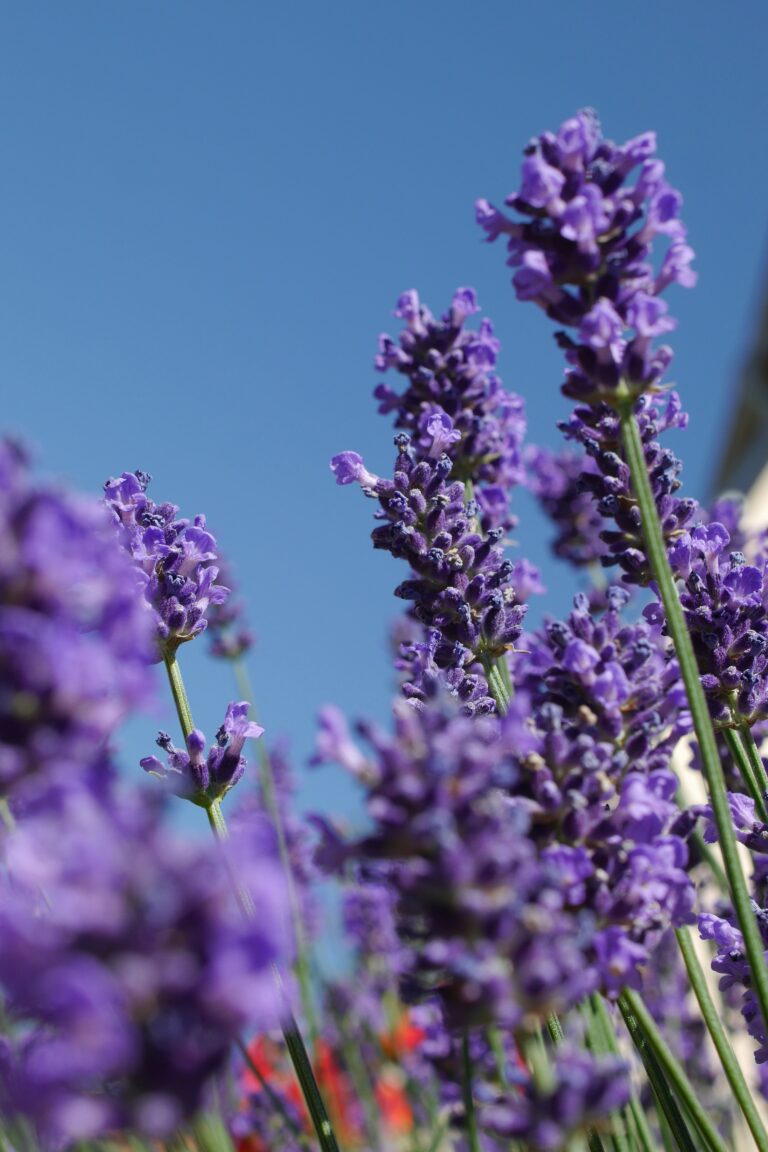
Choosing a natural or organic perfume isn’t necessarily depriving yourself… just opting for a lavender eau de toilette. Turning to organic alternatives means choosing transparency, respecting your skin, and refusing to inhale a petrochemical cocktail whose long-term effects still partly escape us.
Natural materials are complex, living, often more volatile, but they offer overall safety that synthesis can never guarantee. Faced with a market where “greenwashing” blooms as much as jasmine, here’s the usual tip: read labels, prioritize recognized certifications, and demand complete ingredient lists.
Feeling a bit lost in the olfactory fog now?
As often, it’s time to scrutinize INCI lists (free ingredient checker) of best-selling conventional perfumes and their natural alternatives. This will help you see clearer.
Red carpet for the upcoming perfume comparison!
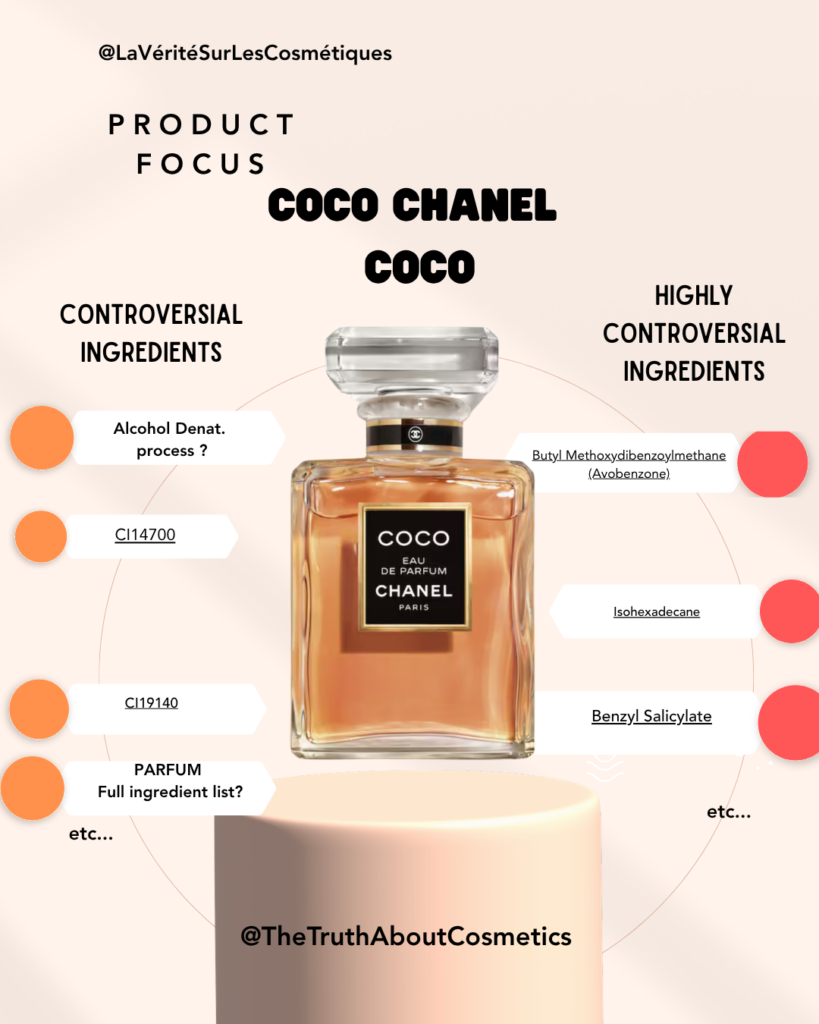
Example : Coco de COCO CHANEL
This is the product’s presentation :
COCO MADEMOISELLE. The essence of a bold and free woman. A feminine ambery fragrance with a strong personality and a surprising freshness.
COMPOSITION
COCO MADEMOISELLE Eau de Parfum is an ambery fragrance, a spirited and voluptuous scent. Sparks of fresh and vibrant orange immediately awaken the senses. A clear and sensual heart reveals the transparent accords of jasmine and rose. The trail unfurls the pure accents of patchouli and vetiver that emphasize the slender structure of the composition.
This almost sounds like a purely natural perfume, doesn’t it ? !
However, the full ingredient INCI analysis reveals a formulation composed of synthetic fragrance substances and controversial chemicals, including endocrine disruptors.
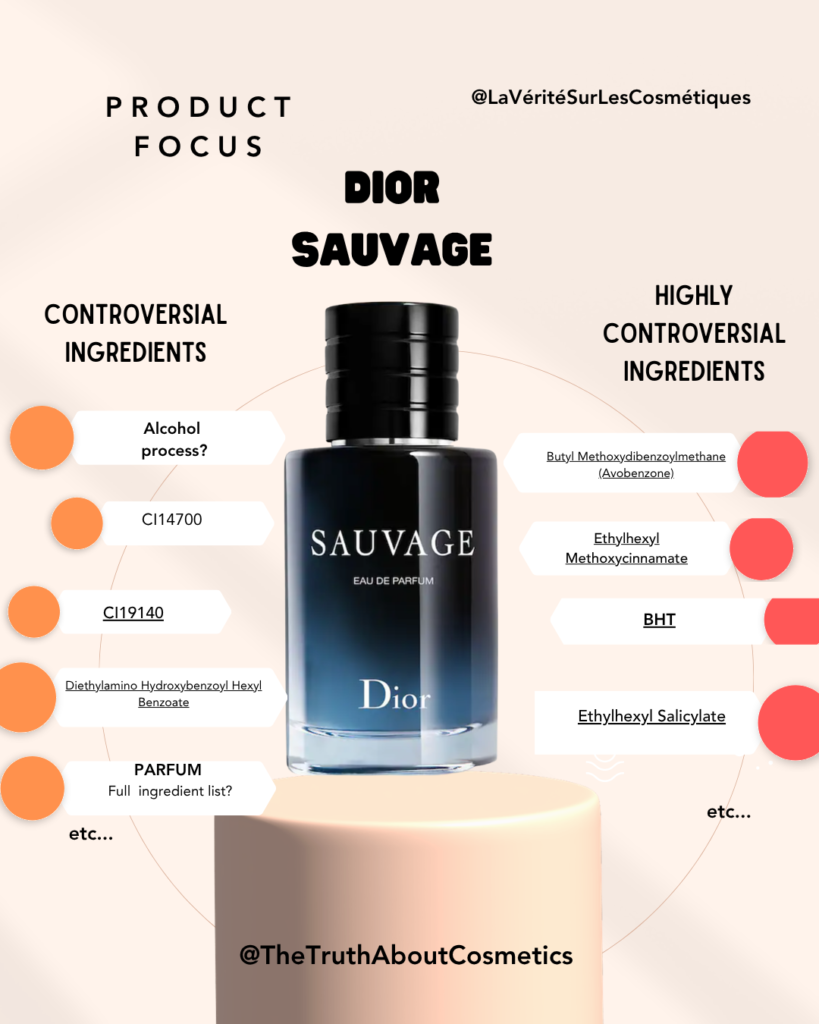
DIOR SAUVAGE – eau de parfum
This is the product’s presentation :
The beating heart of the composition, the precious essence of Vietnamese oud – sourced from a Dior supplier that complies with the high standards of traceability and practices – leaves its animalic imprint with leather notes in a chiaroscuro of noble woods.
The dark and enveloping essence of Indonesian patchouli contrasts with the light, creamy essences of Madagascan vetiver and Virginia cedarwood. A sensual and powerful base is contrasted by a fresh and aromatic top accord of bergamot and an essence of AOP lavender from Provence.
A composition of unprecedented intensity, matured and macerated for 42 days, resulting in a men’s extrait de parfum with ultimate long-lasting wear and power.
Again we learn about Madagascan vetiver Virginia cedarwood … and lavender from Provence, sounds great !
However, the full ingredient INCI analysis reveals again a formulation composed of chemical fragrance substances and controversial chemicals, including endocrine disruptors.
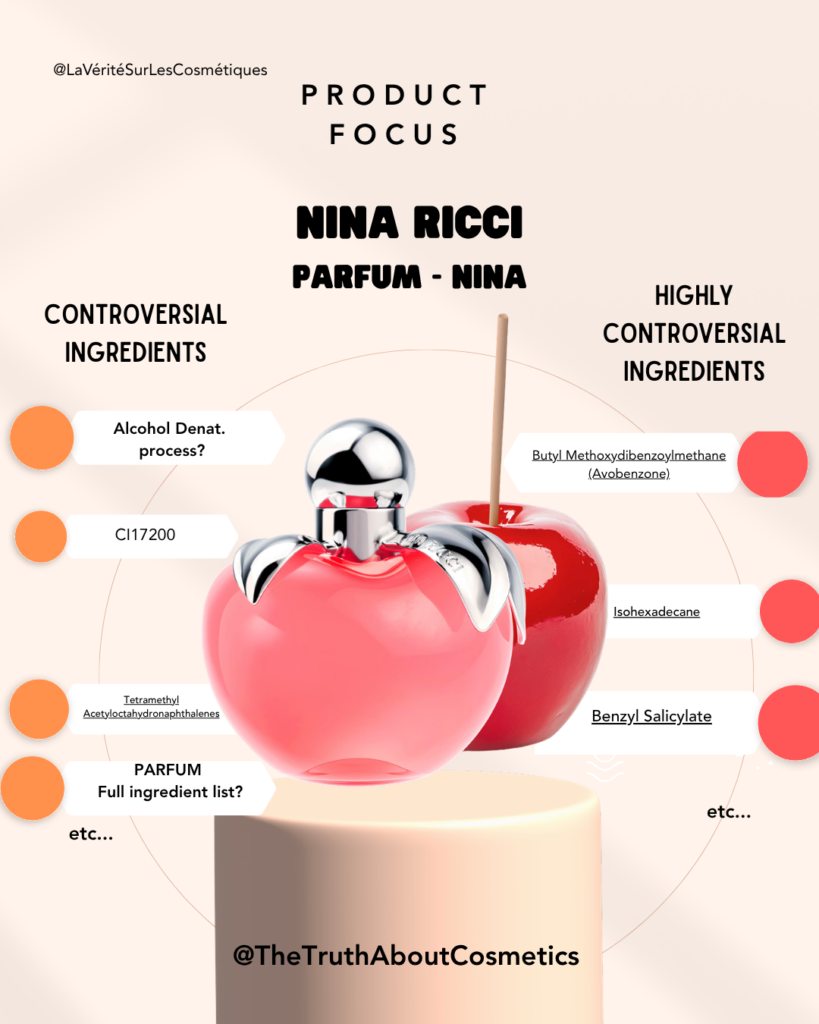
NINA RICCI – NINA
This is the product’s presentation :
From the get-go, mouthwatering bergamot jelly bursts open with a juicy tang, like citrus candy melting on your tongue. It’s followed by creamy pistachio and the radiant glow of white gardenia, blooming with its velvety-soft petals. As the fragrance settles, caramelized vanilla and creamy sandalwood wrap you up in a sweet embrace.
It’s the super addictive signature that you can’t get enough of.
Citrus, gardenia, sandalwood la vanilla… Such a beautiful list of natural fragrances…
However when we have a closer look at the full ingredient INCI analysis it reveals a formulation composed of synthetic fragrance substances and controversial chemicals, including endocrine disruptors, again !
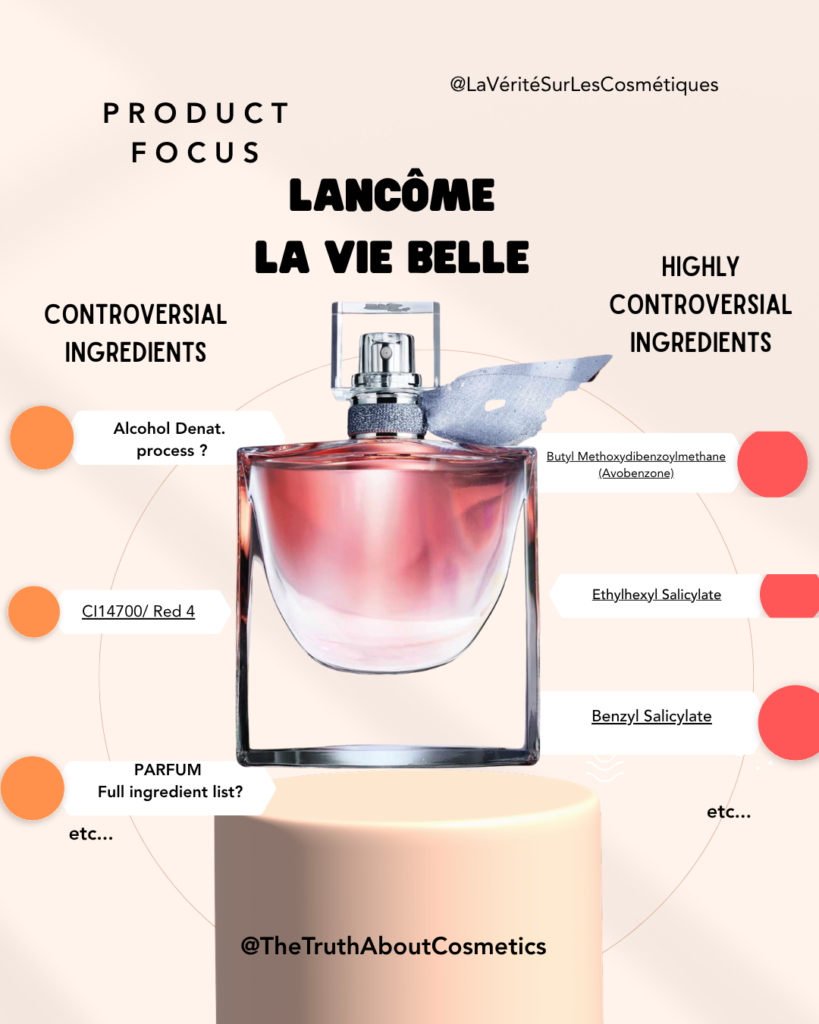
LANCOME – La Vie est Belle
This is the product’s presentation :
A floral gourmand bouquet encapsulated in a crystal smile. Blending the most noble ingredients, La vie est belle is an unforgettable fragrance.
Precious Iris accord with vibrant earthy notes of patchouli, sensual warm vanilla and spun sugar are combined in this scent exclusively created by two of the most renowned French perfumers — Anne Flipo and Dominique Ropion. The art of French perfumery manifested in a unique bottle shape that symbolizes a smile. Each spray will unlock a beautiful day.
And here we talk about Iris, Patchouli and.. Vanilla .. This sounds again like the most natural fragrance..
But same story here , when we have a closer look at the full ingredient INCI analysis it reveals a formulation composed of synthetic fragrance substances and controversial chemicals, including endocrine disruptors, again and again !
Natural and organic certified Fragrances
Shall we have a look at the other side as well ? Here is a selection of different natural and certified (organic) perfumes…
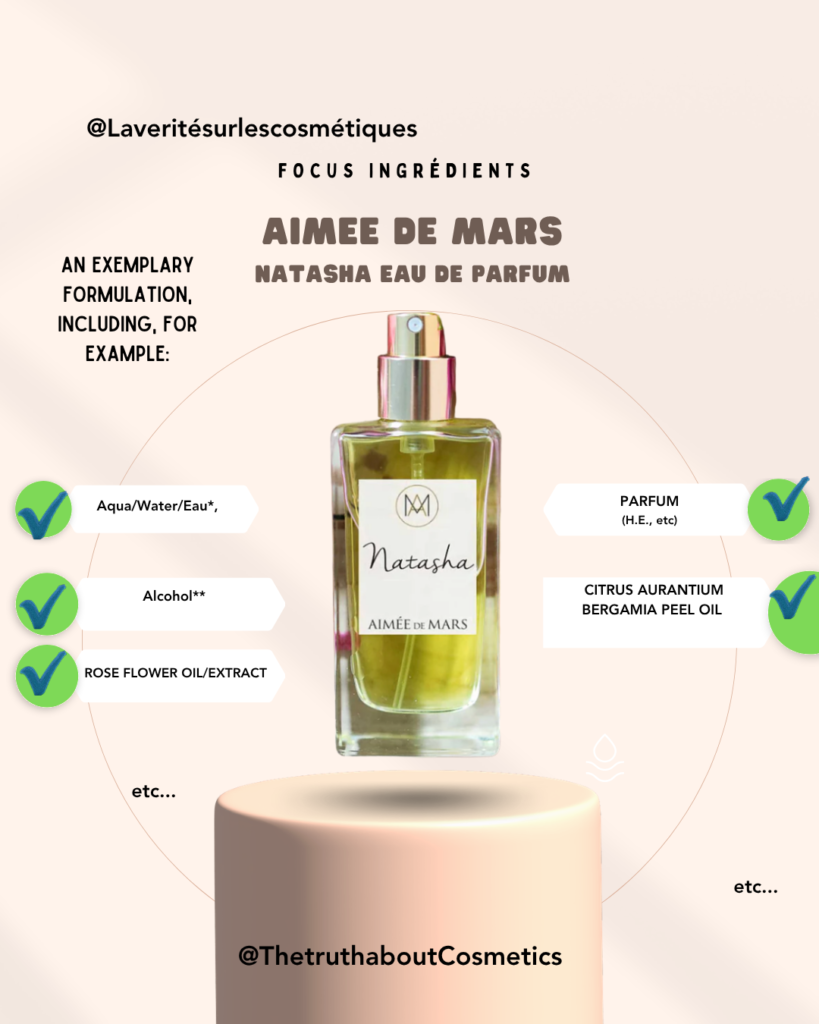
AIMEE de Mars -Natasha
Product Details:
The natural perfume Natasha has the softness of a rain of roses and white flowers, combined with the power of Oud and the strength of Cedar.
Top Notes: Calabrian bergamot, honeysuckle.
Middle Notes: Damask rose, orange blossom, frankincense.
Base Notes: Namibian myrrh, labdanum, Laotian oud, saffron from the Loiret.
This fragrance also highlights natural ingredients: flower extracts, spices, frankincense, citrus fruits…
The INCI analysis confirms that it is a truly natural perfume, free from controversial substances.
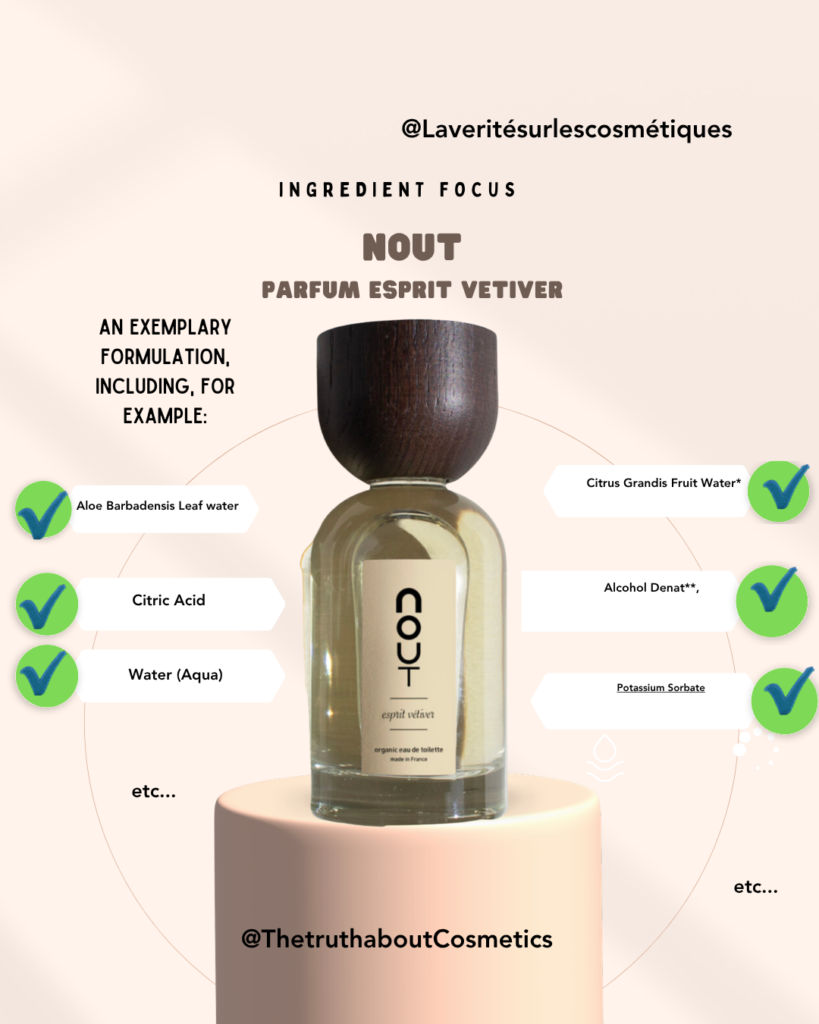
NOUT – Esprit Vetiver
Here’s how the perfume is presented:
Harvested from the very heart of its essence, the vetiver is elevated here to offer you its powerful, multifaceted fragrance: grapefruit seeds, spices, and cedar wood. A perfect balance between freshness and intensity, between elegance and naturalness.
Spicy and fresh woody, Esprit Vétiver is a certified organic, unisex, and vegan eau de toilette.
This fragrance also highlights natural ingredients: vetiver, spices, cedar wood, citrus fruits…
Looking at the full ingredient (INCI) list confirms that it is also a truly natural fragrance, free from controversial substances.
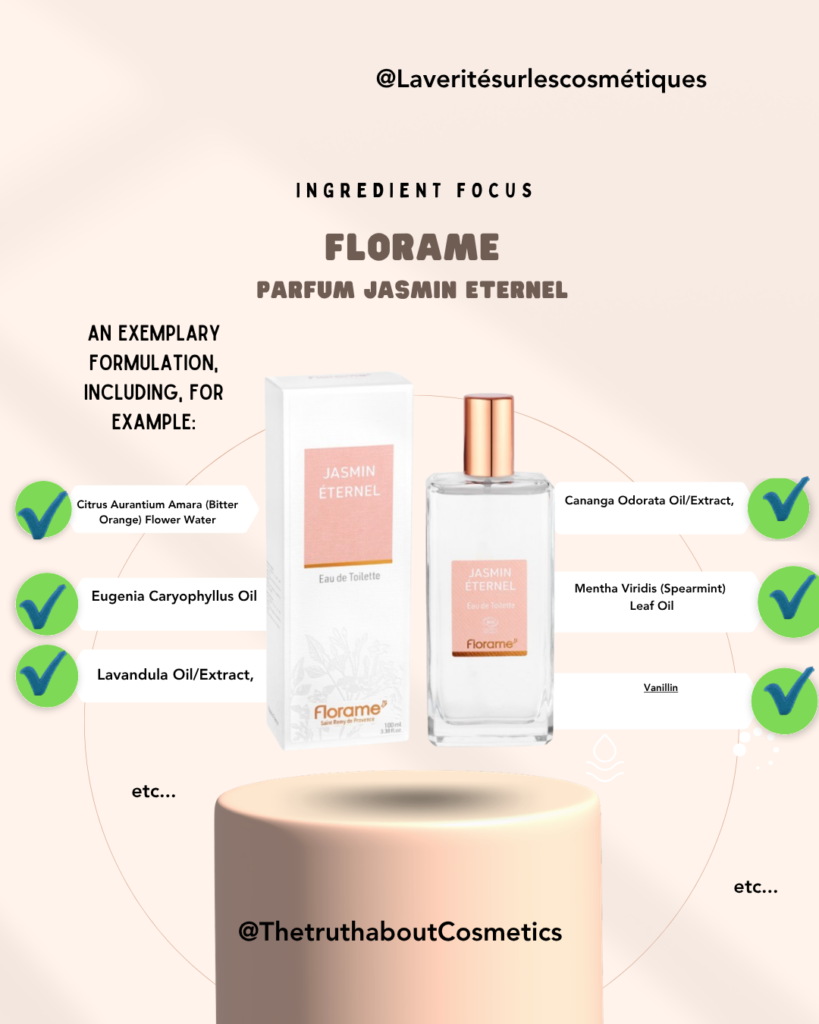
FLORAME – L’eau de jasmin
Here’s how the perfume is presented:
Elegant and sensual, Eau de Jasmin envelops your skin with its precious and floral notes, enhancing it with a delicate, timeless fragrance.
The softness of a summer evening.
Top Notes: Peach, mugwort, rose, clove
Middle Notes: Jasmine, orange blossom, ylang-ylang
Base Notes: Vanilla, myrrh
Once again, this fragrance highlights flowers, plant extracts, and natural aromas…
Checking the INCI list confirms it: a truly natural perfume, free from controversial substances.
❓ FAQ: Natural vs. Synthetic Perfumes Comparison❓
Q: Why do conventional perfumes contain undisclosed fragrance substances?
R: The terms “Parfum” or “Fragrance” allow manufacturers to avoid listing the hundreds of synthetic substances that make up the perfume. In contrast, the 81 regulated allergens (primarily derived from essential oils) must be declared if they exceed a certain threshold.
Q: Are essential oils in organic perfumes “dangerous”?
R: No, when they are properly dosed in a cosmetic formula. The risks associated with essential oils mainly come from improper personal use (applying them undiluted, not respecting dosage, etc.). Allergen warnings on labels inform sensitive individuals but do not indicate a general danger.
Q: What is an endocrine disruptor in a perfume?
R: It is a chemical substance (such as certain synthetic musks, phthalates, or UV filters) capable of interfering with the hormonal system, potentially affecting fertility or long-term health. These are commonly found in conventional perfumes.
Q: How can I recognize a truly natural or organic perfume?
R: Organic labels (Cosmos Organic, Ecocert, Natrue, Soil Association, BDIH, Cosmébio) guarantee the absence of synthetic fragrances and other controversial substances found in conventional perfumes. If the product is not certified by a label, an analysis of the INCI list is necessary.
Related posts:
- Unveiling the Truth: Mouthwash Product Test Reveals Toxic or Polluting Ingredients and Safe Alternatives
- Switching to non toxic beauty products, selection of face moisturizers
- How Perimenopause Changes Your Skin — and How to Adapt Your Skincare Routine
- Cosmetics and Essential Oils : Why the Ongoing Mistrust in France…and elsewhere?