La Mer : Broad Spectrum SPF 50 UV Protecting Fluid -Ingredients Decoded
“Healing energies from sea to skin.” It’s a poetic promise, almost spiritual, served up by La Mer, that iconic brand claiming to blend science, craftsmanship, and renewal. Their website speaks of a founder’s quest to unlock the self-regenerative power of Giant Sea Kelp, of a “Miracle Broth™” fermented for months under light and sound waves.
It sounds wonderful, doesn’t it?
But here at “The Truth About Cosmetics,” we don’t just swallow marketing claims whole. We look behind the curtain.
And for the Broad Spectrum SPF 50 UV Protecting Fluid, the verdict is harsh: behind the luxury packaging and promises of regeneration lies a sunscreen formulation stuck in the past, packed with controversial chemical filters.
Luxury Marketing vs. Chemical Reality: The Great Disconnect
The brand proudly displays its “Formulated Without Parabens, Phthalates, Sulfates” badge.
It’s a classic “clean-washing” tactic designed to lower our guard. “It’s luxury, it’s safe,” the packaging seems to whisper.
But let’s look at the INCI list—the only tangible truth in cosmetics—and dissect it.
The shock hits immediately
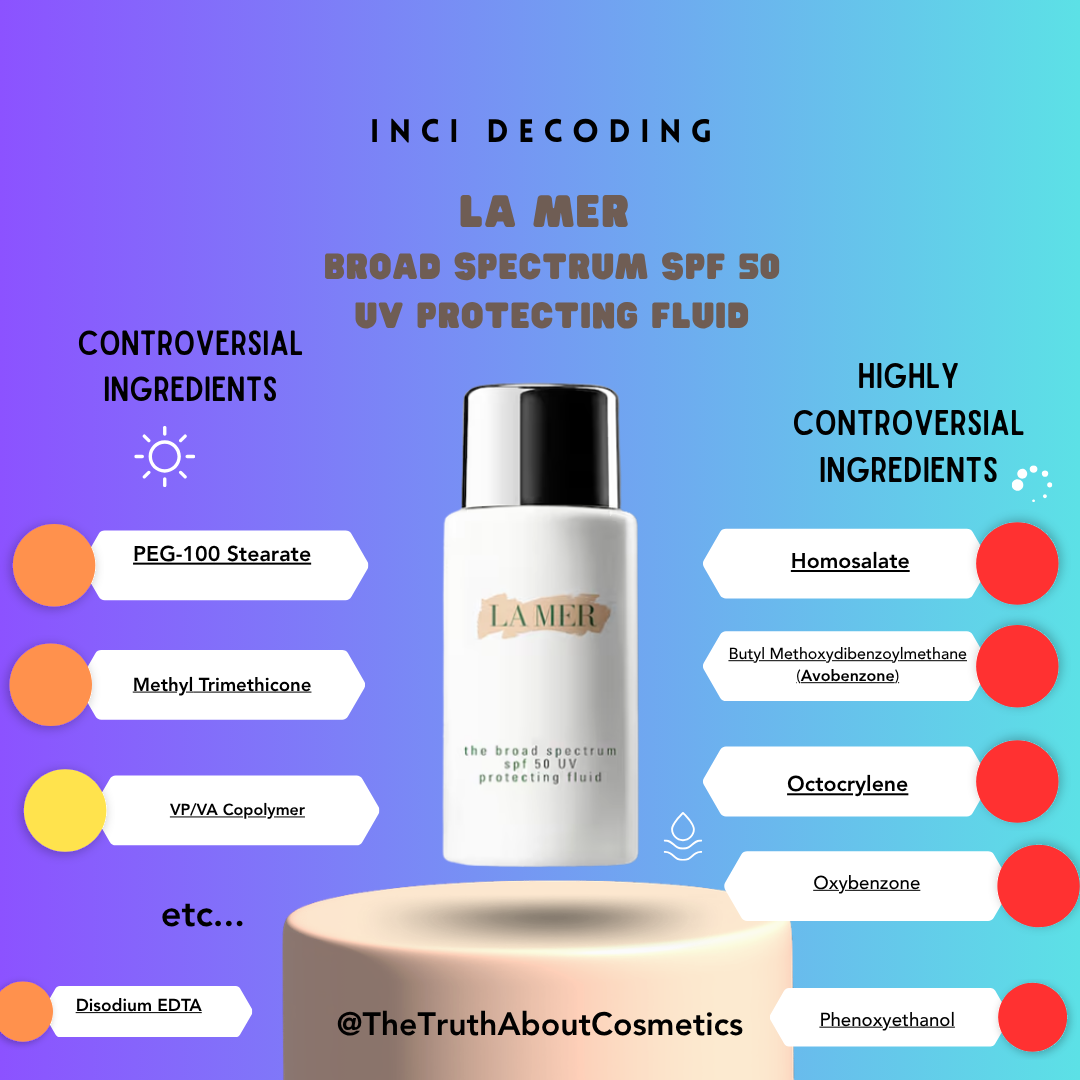
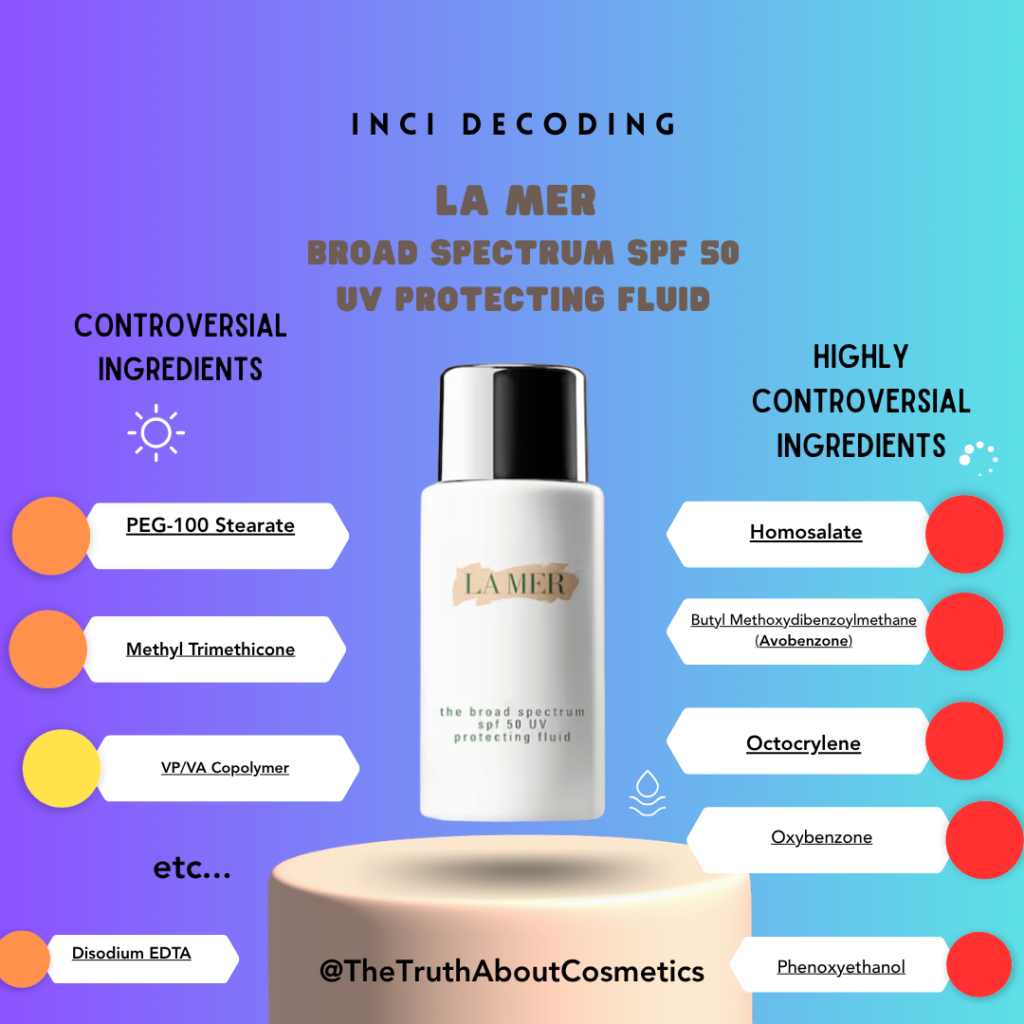
The foundation of this protective fluid relies on a cocktail of the most problematic chemical UV filters on the market. Forget the marine gentleness for a moment; here is what you are actually applying to your skin:
- Avobenzone: Suspected endocrine disruptor.
- Homosalate: Also suspected of hormonal disruption.
- Octocrylene: Another potential endocrine disruptor, and no friend to the environment.
- Oxybenzone: The classic controversial filter, known for being allergenic and disruptive.
La Mer Broad Spectrum SPF 50 UV Protecting Fluid : What’s Really Inside ?
Avobenzone, Homosalate, Octisalate, Octocrylene, Oxybenzone, Water\Aqua\Eau, Butyloctyl Salicylate, Methyl Trimethicone, Neopentyl Glycol Diheptanoate, Aleurites Moluccana (Kukui) Seed Oil, Lauryl Peg-9 Polydimethylsiloxyethyl Dimethicone, Peg-100 Stearate, Butylene Glycol, Glyceryl Stearate, Dipentaerythrityl Tri-Polyhydroxystearate, Potassium Cetyl Phosphate, Algae (Seaweed) Extract, Sesamum Indicum (Sesame) Seed Oil, Medicago Sativa (Alfalfa) Seed Powder, Helianthus Annuus (Sunflower) Seedcake, Prunus Amygdalus Dulcis (Sweet Almond) Seed Meal, Eucalyptus Globulus (Eucalyptus) Leaf Oil, Sodium Gluconate, Copper Gluconate, Calcium Gluconate, Magnesium Gluconate, Zinc Gluconate, Tocopheryl Succinate, Niacin, Sesamum Indicum (Sesame) Seed Powder, Laminaria Ochroleuca Extract, Malachite, Caffeine, Sorbitol, Sodium Hyaluronate, Cetyl Alcohol, Stearic Acid, Vp/Eicosene Copolymer, Ethylhexylglycerin, Saccharide Isomerate, Caprylic/Capric Triglyceride, Caprylyl Glycol, Ammonium Acryloyldimethyltaurate/Vp Copolymer, Dehydroxanthan Gum, Sodium Dehydroacetate, Citric Acid, Tourmaline, Styrene/Acrylates Copolymer, Silica, Peg-8 Laurate, Fragrance (Parfum), Disodium Edta, Phenoxyethanol, Limonene, Geraniol, Hydroxycitronellal, Linalool, Citronellol, Mica, Green 5 (Ci 61570), Titanium Dioxide (Ci 77891)
La Mer Broad Spectrum SPF 50 UV Protecting Fluid
Ingredients Analysis
The famed “Miracle Broth™,” that cellular elixir so heavily promoted, is indeed present, lost somewhere in the middle of the list. But let’s be honest: what is its actual ability to “flood skin with energy” when faced with such a high concentration of synthetic chemistry?
The answer is likely as thin as the layer of this fluid once absorbed.
A Formula Heavy with Consequences
Beyond the highly problematic UV filters, the ingredient list reads like a catalog of what one should avoid in a healthy, responsible routine.
The silky texture, that signature “luxury touch,” is achieved -among other ingredients, through silicones (Methyl Trimethicone, etc.). Pleasant to feel, yes, but they are persistent pollutants, poorly biodegradable, accumulating in our environment.
We also find PEGs -ethoxylated compounds, derived from heavy industrial processes using reactive gases. These agents increase skin permeability, potentially facilitating the penetration of other undesirable substances.
And let’s not forget Disodium EDTA, a poorly biodegradable chelating agent, or Phenoxyethanol, that controversial synthetic preservative whose usage is restricted yet remains debated.
And then there’s the Fragrance (Parfum), that black box capable of hiding dozens of others substances without the consumer having any way of knowing what they are actually applying.
Sun Protection: Yes, But at What Cost?
So, does this La Mer fluid protect from the sun? Yes, undeniably. It hits its SPF 50 target.
But that’s not the question. The real question is: at what cost to your health and the planet?
Protecting yourself shouldn’t mean exposing yourself to a cocktail of endocrine disruptors.
Relying exclusively on controversial chemical filters for daily protection reflects an outdated formulation philosophy, especially when safer alternatives (mineral filters, for instance) exist on the market.
The verdict is clear
We are facing a luxury product with a “low-cost” approach to health safety. The marketing speaks of regeneration and marine energies, but the reality of the formula screams “heavy chemistry.”
The “Miracle Broth” seems powerless to counterbalance such a list of problematic ingredients.
There are far better options out there—often more respectful of your skin and the environment, and let’s be frank, usually cheaper. Don’t let brand prestige make you forget the essentials: the truth is always in the ingredient list.
FAQ La MerProtecting Fluid SPF 50 UV
1. Does La Mer SPF 50 contain endocrine disruptors?
Yes, the analysis of its INCI list reveals the presence of several chemical UV filters suspected of being endocrine disruptors, such as homosalate, octocrylene, and oxybenzone.
2. Does the “Miracle Broth” in La Mer compensate for the controversial ingredients?
No. While this active ingredient is heavily marketed, it is present in low concentrations compared to the base of the formula, which relies heavily on chemical filters and other chemical substances like silicones.
3. Why is this product considered greenwashing?
The brand communicates on the absence of parabens and sulfates and highlights its marine ingredients, while using a base of controversial UV filters and texture agents (silicones, PEGs) harmful to health and the environment.
4. Are there healthier alternatives to this La Mer sunscreen fluid?
Absolutely. There are numerous sunscreens using mineral filters or other filters without endocrine disruptors, often at a lower price point and with a better environmental impact.
Learn to Decode Your Beauty Products Properly
Don’t be fooled anymore by “free-from” claims or stories of mystical fermentation. Understanding an INCI list is your best weapon to:
- Learn to Identify endocrine disruptors and other controversial ingredients.
- Detect greenwashing and fallacious marketing arguments.
- Choose products that are genuinely safe for your health.
Take back power over your beauty routine. The truth isn’t sold in a luxury jar; it’s read line by line in the composition.