the truth about cosmetics

Facial Sunscreens Under the Microscope: SUPERGOOP vs MÁDARA Ingredient Breakdown

The “Cosmeto Match” of Facial Sunscreens: SUPERGOOP vs MÁDARA

In the Cosmeto Match series, we regularly compare two similar products from two different brands—one from the conventional cosmetics sector, the other from certified natural and organic cosmetics.

Both products compete on the same field: ingredient comparison.
Throughout the match, the commentator guides you step by step, explains the rules when necessary, and decodes cosmetic formulations.
Let the match begin—may the best formula win.

Conventional vs Certified Organic Sunscreens: Different Formulation Approaches

Sunscreen manufacturers do not all work the same way. On one side, conventional cosmetics rely on a wide range of ingredients that are authorized under public health regulations and European cosmetic law. However, among these authorized substances, many remain highly controversial.

On the other side, certified natural and organic cosmetics operate with a much more restricted list of ingredients. Substances considered problematic, potentially toxic, polluting, or controversial are simply excluded by certification standards.

When it comes to sun protection, the main difference lies in UV filters:

  • Conventional sunscreens often use chemical UV filters, or a mix of chemical and mineral filters.
  • Certified organic sunscreens primarily rely on mineral filters (titanium dioxide* and zinc oxide), while offering the same standardized SPF protection levels.

The Shared Goal: Effective Sun Protection

In both cases, the objective is the same: effective protection against UVA and UVB rays.
Sun protection should never be taken lightly—especially for children and babies. Protecting the skin against melanoma risk and premature skin aging is essential.

However, sunscreen alone only provides partial protection. Factors such as skin phototype, location, exposure time, medical history, and the quantity of sunscreen applied are often overlooked. Many consumers—and even professionals—are unclear about what SPF numbers actually mean, beyond recommending higher SPF or more expensive products.

Product Comparison: Two Very Different Approaches

In both products, UV protection is the goal. Yet one relies mainly on synthetic ingredients and controversial substances, while the other opts for natural ingredients approved in certified organic cosmetics.

Team 1: SUPERGOOP

SUPERGOOP Unseen Sunscreen SPF 50 PA++

50 ml – $38

According to the brand:

« A weightless gel that feels comfortable and breathable on skin with a natural finish. Recommended for normal, combination, dry, oily, sensitive or acne-prone skin. »

Key Claims

  • Non-greasy & non-irritating formula
  • Makeup primer
  • Dermatologically tested
  • Vegan & cruelty-free
  • Suitable for all skin types

Marketed as a “revolutionary” sunscreen, the question remains: what is truly innovative here?

SUPERGOOP Sunscreen – INCI List

Ingredients (INCI):  Active ingredients : Avobenzone 3%, Homosalate 7%, Octisalate 5%, Octocrylene 9%

Other ingredients : Isododecane, Dimethicone/Bis-Isobutyl PPG-20 Crosspolymer, Dimethicone/Vinyl Dimethicone Crosspolymer, Dimethicone, Dimethicone Crosspolymer, Caprylic/Capric Triglyceride, Butyrospermum Parkii (Shea) Butter, Physalis Angulata Extract, Himanthalia Elongata Extract, Meadowfoam Estolide, Tocopherol, Jojoba Esters, Polymethylsilsesquioxane, Caprylyl Glycol, Diethylhexyl Syringylidenemalonate, Silica, Bisabolol, Dipotassium Glycyrrhizate.

Ingredient Analysis – SUPERGOOP

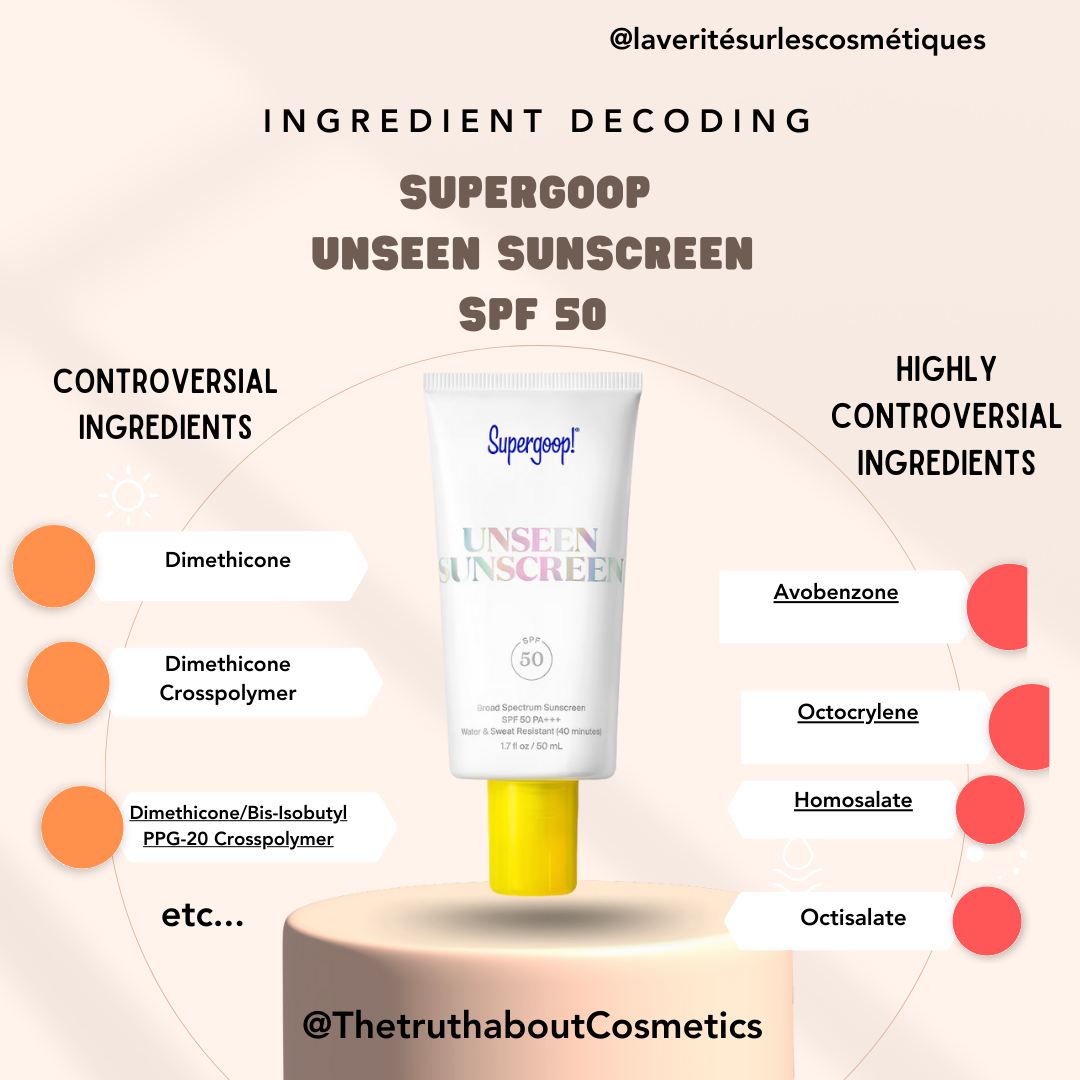
The first 5–8 ingredients define the product’s profile. Here, we immediately find multiple controversial chemical UV filters, silicones, and petrochemical-derived ingredients.

Controversial ingredients include:

  • Ethylhexyl Salicylate (Octisalate) – suspected endocrine disruptor
  • Avobenzone – suspected endocrine disruptor
  • Octocrylene – suspected endocrine disruptor
  • Homosalate – suspected endocrine disruptor
  • Multiple silicones – polluting, poorly biodegradable
  • Isododecane – mineral oil derivative

Verdict – SUPERGOOP

While this formula does provide UV protection, it relies heavily on controversial chemical filters, polluting silicones, and mineral oil derivatives.
Far from revolutionary, it represents one of the most problematic sunscreen formulations currently on the market.

Supergood : ingredient decoding

Team 2: MÁDARA

MÁDARA Anti-Age Mineral Facial Sunscreen SPF 30

40 ml – €32,95

This natural mineral sunscreen provides broad-spectrum UVA/UVB protection with an invisible finish.

MÁDARA Sunscreen – INCI List

Aloe Barbadensis (Aloe) Leaf Juice*, Zinc Oxide, Isoamyl Laurate, Dicaprylyl Carbonate, Glycerin**, Sorbitan Olivate, Cera Alba (Bees Wax)*, Lecithin, Polyglyceryl-2 Dipolyhydroxystearate, Silica, Cellulose, Dracocephalum Ruyschiana (Dragonhead) Cell Culture Extract, Camellia Sinensis Leaf Extract, Quercus Robur (Oak) Bark Extract, Vitis Vinifera (Grape) Seed Extract, Hydrolyzed Hyaluronic Acid, Sodium Hyaluronate, Sodium Chloride, Aroma/Fragrance, Rubus Idaeus (Raspberry) Seed Oil*, Sorbitan Caprylate, CI 77492 (Iron oxide)****, Palmitic Acid, Stearic Acid, Propanediol, Benzoic Acid, CI 77499, CI 77491 (Iron oxides)****, Aqua/Water, Ascorbyl Palmitate (Vitamin C), Sodium Phytate, Tocopherol (Vitamin E), Potassium Hydroxide, Benzyl Salicylate***, Limonene***, Citral***, Linalool***, Eugenol***

Ingredient Analysis – MÁDARA

The formula is built on hydrating and lipid-replenishing ingredients, including aloe vera, glycerin, beeswax, and plant-derived oils.
Zinc oxide (non-nano) ensures mineral UV protection, fully compliant with organic certification standards.

Verdict – MÁDARA

A balanced formulation using mineral UV filters, free from controversial ingredients, and respectful of both skin and environment.

Madara : beauty label decoder

FAQ – Facial Sunscreen Ingredients

What is the difference between chemical and mineral sunscreens?

Chemical sunscreens absorb UV rays, while mineral sunscreens reflect them using zinc oxide or titanium dioxide.

Are mineral sunscreens less effective?

No. Certified mineral sunscreens offer standardized, reliable UVA/UVB protection.

Why decode sunscreen ingredient lists?

Ingredient decoding helps identify controversial substances and understand environmental and health impacts.
 Two shampoos for curly and frizzy hair confronting each other in a cosmetic « match ».

« Dark N Lovely » against « Noire O Naturel »

In this chapter we will regularly be presenting two comparable products from two different brands, very often one from the « conventional » sector and the other from a certified, organic brand. The products, shampoos curly & frizzy hair, will be facing each other on the same ground : the ingredients list comparaison. The commentator will remain at your side during the entire game and will also be explaining the basic rules, when they’re not completely clear or understandable.

Let the game begin : may the best team win ! For this month’s match, we have selected two hair care products : two different shampoos – curly and frizzy hair.

In the following product comparaison, both brands are aiming at the same goal :  specific products for washing hair your properly and hair care in general for curly and fuzzy hair. But on one side, the product uses mainly chemical ingredients, -with some controversial ingredients that slipped in between the lines-, whereas the other side plays the game of «natural ingredients only ».

Match opening, team presentation :

Dark N Lovely «Au Naturale»

Moisture – Replenishing Shampoo

with Mango Oil & Bamboo Milk

250 ml, price : 9,49 €

« Recipe for rich, natural hair.»


This brand belongs to the l’Oréal group and the product obviously targets an international consumer market (the product in itself is both in french and english).

Here’s how the brand itself presents the product :

«Our Moisture Replenishing Shampoo cleanses and provides a rich, quick lather that brings moisture for hair and scalp » Another claim, meant to be reassuring  :

« No mineral Oil, No parabens, NO Petrolum »

Well, well, well…

Let’s take the time to check the entire ingredient list and to analyse this INCI list in detail :

Ingredients / INCI : Aqua, Cocamidopropyl Betaine, Sodium Laureth Sulfate, Cocamide MEA, Sodium Chloride, Parfum (Fragrance), Phenoxyethanol, Polyquaternium-7, Polysorbate 20, Potassium Sorbate, Glycol Stearate, Mangifera Indica Seed Oil, Caprylic/Capric Triglyceride, Polyquaternium-10, Citric Acid, Sodium PCA, Disodium EDTA, Sodium Benzoate, Benzyl Salicylate, Linalool, Benzyl Alcohol, Bambusa Vulgaris, CI19140, CI47000, CI17200, CI42090


As always, it’s the 5-8 (approx.) first ingredients in a cosmetic product, that define the product’s overall « profile ».

In general, products like shampoos (or shower gels, for instance, too) are made of around 70% water, followed by surfactants (approx. 20%) and other remaining secondary ingredients. When it comes to shampoos, (shower gels, etc) the most essential part remains the choice of appropriate surfactants.  These surfactants can be either very soft, -very well tolerated by the skin-, or more or less irritating, some can also be problematic for the environnement. In this specific product, there is a mixture of an irritating surfactant, Sodium Laureth Sulfate, associated with a softer surfactant, Cocamidopropyl Betaine. But the rest of the formulation can also be considered as problematic, as it includes some controversial synthetic preservatives, other ingredients that are problematic for the environment (polluting substances), and even some controversial azo dyes.

Here’s the detail of what could be considered as problematic in the product’s formulation,

  • Phenoxyethanol; a controversial synthetic preservative, concern of organ system toxicity (liver) and classified as irritant.
  • Polyquaternium-7 and Polyquaternium-10 which are quats, substances that are not very well biodegradable and considered slightly irritating.
  • The Polysorbate belongs to the PEG category, which are ethoxylated ingredients. Ethoxylated ingredients on their own are of low concern, however, the process of ethoxylation is a a complex chemical procedure requiring extreme safety mesures (toxic and reactive gas). PEGs are also suspected to make the skin more permeable, enabling therefore the accumulation of more problematic ingredients. PEGs are also not very well biodegradable and therefore polluting.
  • Other ingredients that are problematic for the environnement, as Disodium EDTA, for ex.
  • The CI19140 and CI17200 colorants ; they belong to the group of azo dyes, coal-tar chemicals that are sometimes allergenic and linked to other toxicological concerns.
  • The « Fragrance » in the INCI listing can also sometimes be considered as problematic :as this product is not a certified organic product, it probably contains some synthetic fragrance. Synthetic fragrances very often also contain phtalates, classified as endocrine disruptors.

Of course there is also the Mango Oil (11th position) and the Bamboo Milk (21th position), but they can be considered as mere, -nearly insignificant-, « natural hints »  as they don’t play any major role in the product’s formulation. They are basically just there to give the product a « greener » outlook, but not as active, relevant cosmetic ingredients. Another surprising element ; the bottle in itself really looks like a beverage bottle, an orange juice bottle to be more precise.

This product should therefore not be left unattended in the kitchen, if you have small children around, for instance.

This is therefore a perfect «greenwashing example » ; using one or two main natural ingredients, like the ‘Mango Oil and Bamboo Milk’ as major sales argument. But these natural ingredient play in fact no significant, major role in this product.The global formulation is mainly based on chemical ingredients, some of which are highly controversial and problematic for the environnement..

Sentence: « No mineral Oil, No parabens, NO Petrolum », so far so good !… BUT «with» Phenoxyethanol, EDTA, azo dyes and a whole range of other controversial or problematic ingredients. A product that could benefit from improvements, on every possible level…

*********************

Noire Ô Naturel

Crème de Shampooing

Aloe Vera, Mongogo, Sesame

Curly to frizzy hair

200 ml , price : 16,50 €

Here’s how the brand itself presents the product :

« Inspired from african beauty rituals, our cream of shampoo is made of plant butters ( shea, mango) and organic aloe vers juice known for their hair care benefits. Its very soft and SLS free formulation gives it its creamy texture without foam for a softly shampoo care. An enriches formula with organic oils (sesame, coconut) and mongongo soothes and nourishes your hair from roots to tips. »

Let’s take the time to check the entire ingredient list and to analyse this INCI list in detail :

Ingredients / INCI : Aloe Barbadensis Leaf Juice*,Aqua (Water), Helianthus Annuus (Sunflower) Seed Oil, Beeswax *, Cetearyl Alcohol, Lauryl Glucoside, Butyrospermum Parkii (Shea) Butter*, Inulin, Arachidyl Alcohol, Yogurt Powder, Betaine, Decyl Glucoside, Glycerin, Mangifera Indica (Mango) Seed Butter, Coco-Glucoside, Schinziophyton Rautanenii Kernel Oil, Sesamum Indicum (Sesame) Seed Oil*, Cocos Nucifera (Coconut) Oil*, Cananga Odorata Flower Oil, Aniba Rosaeodora (Rosewood) Wood Oil, Rosmarinus Officinalis (Rosemary) Leaf Oil,  Behenyl Alcohol, Tocopherol, Coco-Glucoside, Glyceryl Oleate, Arachidyl Glucoside, Dehydroacetic Acid, Sodium Hydroxide, Citric Acid, Benzyl Alcohol, Linalool.

* ingrédients issus de l’agriculture biologique 98% of the ingredients (total) are of natural origin 53% of the ingredients (total) are organic certified Without SLS or ALS, paraben, silicon, GMO,  artificial  colorants or perfumes.

« Cosmétique Ecologique » certified by ECOCERT Greenlife according to ECOCERT guidelines, more details to be found here 


As always, it’s the 5-8 (approx.) first ingredients in a cosmetic product, that define the product’s overall « profile ».

In general, products like shampoos are made of around 70% water, followed by surfactants (approx. 20%) and other secondary ingredients, then.When it comes to shampoos, (or shower gels, for instance, too), the most essential part remains the choice of the proper surfactants. These surfactants can be either very soft, very well tolerated by the skin, or more or less irritating and as well problematic for the environnement.This formulation is based on a mixture of sugar-based surfactants (acylgutamates) Lauryl Glucoside and Decyl Glucoside, and  Coco-Glucoside (a bit further down the line).

These are the softest surfactants available, the ones that are also best tolerated by the skin. But these substances are also the most expensive ones, these surfactants are therefore very rarely used as primary, (main) surfactants in one product, like for example here. The product is presented as a « crème de shampooing », -a creamy shampoo-, («a creamy, non-foamy texture»), which explains the high number of authentic vegetal oils and waxes, right from the ingredient’s list start.And among the very first ingredients, there’s a vegetal sunflower oil, some organic beeswax, organic sheabutter and other natural ingredients that are particularly hydrating and offer specific skin and hair care like inulin (sugar), yogurt and vegetal glycerin.

Besides the fact that this product does not include any harmful, problematic or controversial ingredient, there is a whole list of entirely natural ingredients and authentic vegetal oils, with their precious intrinsic vegetal substances, like for example :

  • Organic Aloe Vera gel : soothing, hydrating, nourishing and regenerating
  • Mango butter :  emulsifying, skin softening and nourishing properties
  • Mongogo Oil : restructuring, hydrating and regenerating
  • Organic Coco Oil : protecting, skin softening and emulsifying properties, shining hair
  • Organic Sesame Oil : nourishing, softening,  contains precious essential fatty acids

And of course this richness and large quantity of authentic natural ingredients, -mainly organic-, also has an impact on the price, this product is twice as expensive as the previous one, but it also contains twice as many natural high quality ingredients…

Sentence : This « crème de shampooing » presents itself with an exemplary formulation ; without any controversial and harmful ingredient whatsoever, this product derives its strength essentially from « mother nature » and precious natural ingredients, carefully selected for their intrinsic benefits. A prefect hair care product and shampoo for curly to frizzy hair.

Visit the website and the free INCI (cosmetic ingredients) search engine to evaluate your own cosmetic products.


Other products tests:

*******

Note; this article is from 2018

Product formulations can change, even an entire product line can change from year to year. And the brand can choose to remove or add certain ingredients or even entirely remove products, for example. No consumer site or magazine constantly updates these changes, it would be a gigantic job, to do continuously. And the articles are not removed at the simple request of the brands who would explain that the formulas have changed since the test was published.

The product test reflects “the exact image of the moment”,  and the tests are clearly dated.