

Table of Contents
ToggleLegitimate precautions or biased perception?
In France, and elsewhere, cosmetics formulated with essential oils are often under scrutiny in the media. Between legitimate caution and overstated warnings, the use of essential oils in beauty products frequently faces criticism. But are these concerns well-founded—or are they shaped by a biased perception?
Essential Oils: Naturally Potent Substances
Essential oils are well known for their powerful properties: they are naturally rich in active compounds, which explains their effectiveness in both aromatherapy and skincare. However, their use must be carefully managed—some oils can be photosensitizing or trigger skin reactions if applied undiluted or in too high a concentration. Others may not be suitable for children or pregnant women, for example.
Unlike many synthetic chemicals used in conventional cosmetics, essential oils have been known and documented for centuries. Their effects, interactions, and usage guidelines are well established—something that cannot always be said for synthetic compounds, which are often relatively new and lack long-term studies. This is especially true when it comes to the issue of potential interactions between ingredients, commonly referred to as the “cocktail effect.”
The Paradox of Natural and Organic Cosmetics with Essential Oils
Mistrust & bad grades
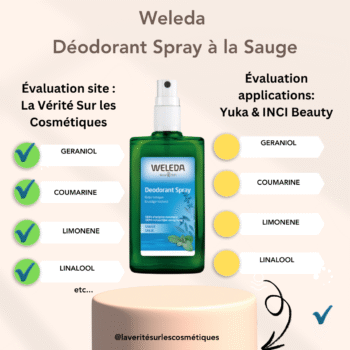
As health-conscious consumers move away from synthetic ingredients, many turn to natural and certified organic cosmetics that use essential oils as alternatives to synthetic fragrances. Yet these same products are often poorly rated in consumer tests or cosmetic rating apps (like Yuka or INCI Beauty) due to the presence of so-called “potential allergens” such as linalool or geraniol—naturally occurring compounds in many essential oils.
Why Essential Oils Are Essential (and Natural) in Cosmetics
In organic certified beauty products, essential oils serve several functions: they provide natural fragrance, deliver active benefits (purifying, soothing, invigorating, etc.), and sometimes aid in product preservation. Organic standards or labels for natural and organic cosmetics prohibit many controversial synthetic preservatives and fragrances, making essential oils a preferred solution.
Replacing essential oils… with synthetic fragrance ?
To exclude essential oils entirely would mean returning to synthetic fragrances, often associated with problematic substances like phthalates (endocrine disruptors), synthetic musks (bioaccumulative), or other potentially toxic or polluting compounds.
Are All Essential Oil Components “Dangerous” ?
EU regulations require that certain “potential allergens” be listed on the label when their concentration exceeds a threshold. This applies to both synthetic fragrances and natural components found in essential oils (e.g., citral, limonene, geraniol).
But should these be categorically avoided?
Research such as the IVDK study in Germany shows that the allergenic potential varies greatly among substances. Some frequently used compounds have very low rates of allergic reaction.
🔬1) IVDK Study on Essential Oil Sensitization (2010–2019)
This study analyzed patch test data from 10,930 patients exposed to 12 different essential oils. Only 8.3% had a positive reaction to at least one oil. Oils with slightly higher reaction rates (>1%) included ylang-ylang, citronella, jasmine absolute, sandalwood, clove, and neroli. The authors noted that sensitization to essential oils is relatively rare and more common in professional settings (e.g., massage therapists, beauticians).
🔗 Read the full study: PubMed
🔬2) Study on Geraniol: Comparing Natural and Synthetic Forms
Another study looked at geraniol, a compound found in several essential oils. It revealed that oxidized geraniol (synthetic form) caused significantly more allergic reactions than its pure form. For example, 0.55% of patients reacted to oxidized geraniol, compared to only 0.13% for pure geraniol.
🔗 Read the study: PubMed
This highlights the need to distinguish between natural and synthetic components of essential oils when discussing skin sensitization. While some reactions can occur, the allergenic potential is generally low and depends on multiple factors including the compound’s form and usage context.

This highlights the need to distinguish between natural and synthetic components of essential oils when discussing skin sensitization.
While some reactions can occur, the allergenic potential is generally low and depends on multiple factors including the compound’s form and usage context.
An Exaggerated Fear of Essential Oils?
Rejecting all products containing essential oil components due to possible allergens seems excessive. In truth, any substance—natural or not—can cause a reaction in sensitive individuals. Just as one avoids strawberries or citrus if allergic, consumers can choose cosmetic products with essential oils suited to their skin profile.
Mentions of components like “geraniol,” “linalool,” or similar are valuable pieces of information—for those who are directly affected. But for everyone else, they’re not particularly relevant.
It’s a bit like the label “contains hazelnuts” on your favorite chocolate bar. It’s crucial for people with a hazelnut allergy, but for others, it doesn’t really matter.
The Role of the French Essential Oils Consortium
The French Essential Oils Consortium (Consortium Huiles Essentielles) emphasizes that essential oils, while natural, are powerful substances that require careful use. Most reported adverse effects are due not to well-formulated cosmetics, but to misuse: applying oils undiluted, excessive self-medication, oral ingestion without supervision, or inappropriate use on children and pregnant women.
In fact, around 90% of reported side effects are linked to improper usage (source: poison control centers in France). Moreover, only about 3.5% of the population in France for example is allergic to fragrance, and only a small portion of those allergies are related to essential oils.
A Rational Approach: Key to Preserving Essential Oils in Cosmetics
Most risks come from misuse—not from the presence of essential oils in properly formulated cosmetics. A reasoned, evidence-based approach would help prevent media distortions and preserve the value of essential oils in clean beauty.
So the real question is: what do we use instead?
Formulas without essential oils, but with synthetic fragrances containing far more controversial substances?
📱 Cosmetic Rating Apps: A Skewed Perspective on Essential Oils?
Apps like Yuka, INCI Beauty, Clean Beauty, and QuelCosmetic have become popular tools for evaluating cosmetic formulations. However, their scoring systems often penalize products containing natural essential oil components like linalool, citral, or geraniol, simply because these are listed allergens—without considering actual concentrations, real-world allergenicity, or the context of use.
As a result, a natural product containing essential oils at safe levels may receive a lower score than a synthetic formula, simply because of the presence of listed components.
For consumers seeking environmentally friendly and physiologically respectful cosmetics, it is essential not to rely solely on app scores, but to understand the context of essential oil use, their natural origin, their function (active ingredient, fragrance, preservative), and especially their real concentration in the formula.
As a result :
A natural product containing essential oils at safe levels may receive a lower score than a synthetic formula, simply because of the presence of listed components.
For consumers seeking environmentally friendly and physiologically respectful cosmetics, it is essential not to rely solely on app scores, but to understand the context of essential oil use, their natural origin, their function (active ingredient, fragrance, preservative), and especially their real concentration in the formula.
Conclusion: Reclaiming Essential Oils in Natural Beauty
Equating essential oils with toxic synthetic components is a flawed comparison. While a minority of people may react to certain essential oil compounds, these are natural, well-studied ingredients used in small concentrations.
Essential oils are essential to the integrity of organic and natural cosmetics. Systematically excluding them under the guise of precaution would mean abandoning a well-documented, plant-based alternative in favor of potentially more harmful synthetic options.
SOURCES :
- https://eur-lex.europa.eu/legal-content/FR/TXT/PDF/?uri=CELEX:32023R1545
- https://pubmed.ncbi.nlm.nih.gov/35417610/
- https://www.consortium-he.org/2019/04/24/demeler-le-vrai-du-faux/
- https://onlinelibrary.wiley.com/doi/10.1111/j.1600-0536.2012.02079.x
- https://www.cosmebio.org/fr/nos-dossiers/2018-09-allergenes-parfum-cosmetique/
Related posts:
- Cosmetic Truth of the Month: DIOR Forever Undercover Foundation
- Cosmetic Truth of the Month: L’Oréal Cell Renew Revitalising Day Cream
- Switching to non toxic beauty products, selection of face moisturizers
- Is CeraVe Ultra-Light Moisturizing Lotion Really the Best Option for Sensitive Skin? A Closer Look at Its Ingredients