

The “Cosmeto Match” of Facial Sunscreens: SUPERGOOP vs MÁDARA
In the Cosmeto Match series, we regularly compare two similar products from two different brands—one from the conventional cosmetics sector, the other from certified natural and organic cosmetics.
Both products compete on the same field: ingredient comparison.
Throughout the match, the commentator guides you step by step, explains the rules when necessary, and decodes cosmetic formulations.
Let the match begin—may the best formula win.
Conventional vs Certified Organic Sunscreens: Different Formulation Approaches
Sunscreen manufacturers do not all work the same way. On one side, conventional cosmetics rely on a wide range of ingredients that are authorized under public health regulations and European cosmetic law. However, among these authorized substances, many remain highly controversial.
On the other side, certified natural and organic cosmetics operate with a much more restricted list of ingredients. Substances considered problematic, potentially toxic, polluting, or controversial are simply excluded by certification standards.
When it comes to sun protection, the main difference lies in UV filters:
- Conventional sunscreens often use chemical UV filters, or a mix of chemical and mineral filters.
- Certified organic sunscreens primarily rely on mineral filters (titanium dioxide* and zinc oxide), while offering the same standardized SPF protection levels.
The Shared Goal: Effective Sun Protection
In both cases, the objective is the same: effective protection against UVA and UVB rays.
Sun protection should never be taken lightly—especially for children and babies. Protecting the skin against melanoma risk and premature skin aging is essential.
However, sunscreen alone only provides partial protection. Factors such as skin phototype, location, exposure time, medical history, and the quantity of sunscreen applied are often overlooked. Many consumers—and even professionals—are unclear about what SPF numbers actually mean, beyond recommending higher SPF or more expensive products.
Product Comparison: Two Very Different Approaches
In both products, UV protection is the goal. Yet one relies mainly on synthetic ingredients and controversial substances, while the other opts for natural ingredients approved in certified organic cosmetics.
Team 1: SUPERGOOP
SUPERGOOP Unseen Sunscreen SPF 50 PA++
50 ml – $38
According to the brand:
« A weightless gel that feels comfortable and breathable on skin with a natural finish. Recommended for normal, combination, dry, oily, sensitive or acne-prone skin. »
Key Claims
- Non-greasy & non-irritating formula
- Makeup primer
- Dermatologically tested
- Vegan & cruelty-free
- Suitable for all skin types
Marketed as a “revolutionary” sunscreen, the question remains: what is truly innovative here?
SUPERGOOP Sunscreen – INCI List
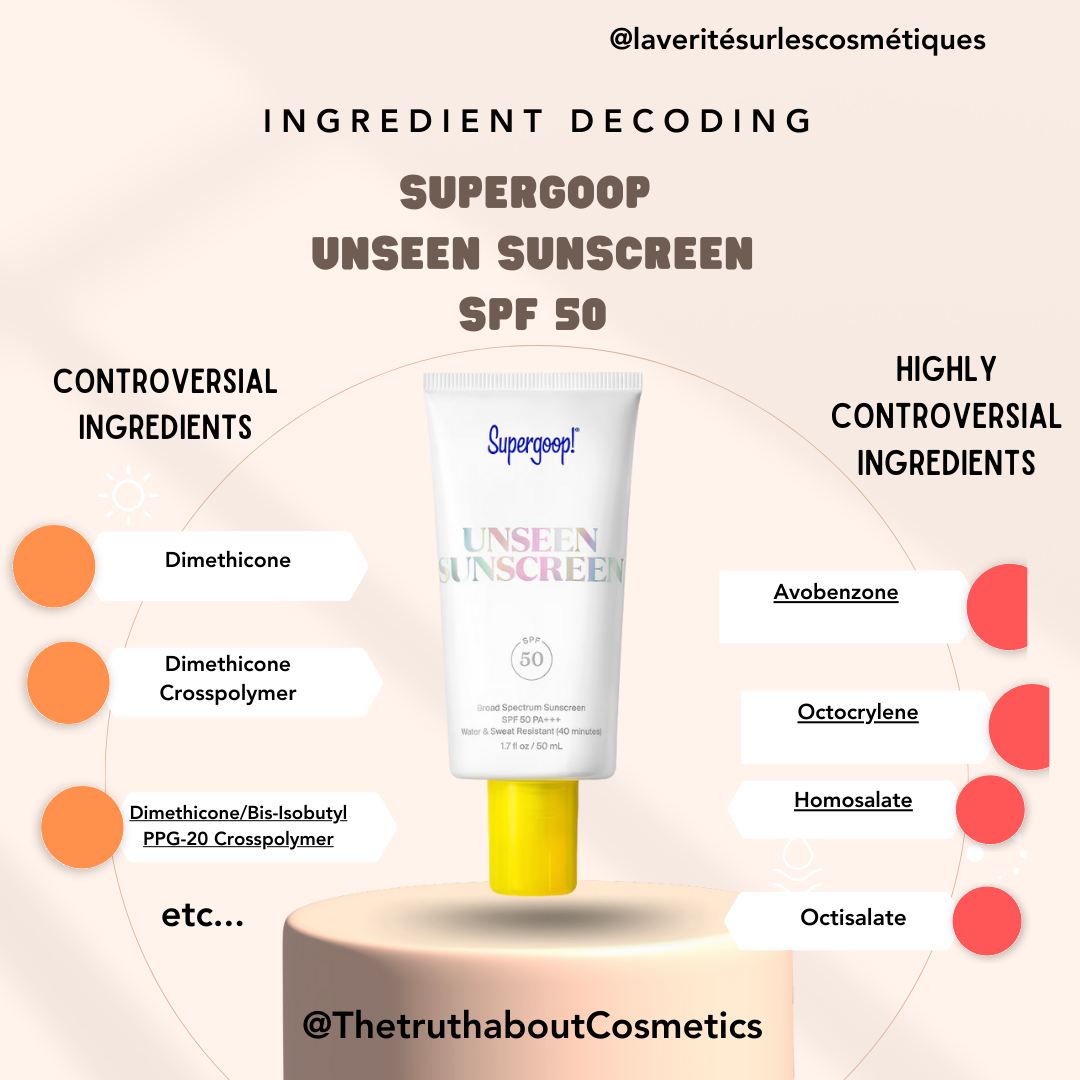
Ingredients (INCI): Active ingredients : Avobenzone 3%, Homosalate 7%, Octisalate 5%, Octocrylene 9%
Other ingredients : Isododecane, Dimethicone/Bis-Isobutyl PPG-20 Crosspolymer, Dimethicone/Vinyl Dimethicone Crosspolymer, Dimethicone, Dimethicone Crosspolymer, Caprylic/Capric Triglyceride, Butyrospermum Parkii (Shea) Butter, Physalis Angulata Extract, Himanthalia Elongata Extract, Meadowfoam Estolide, Tocopherol, Jojoba Esters, Polymethylsilsesquioxane, Caprylyl Glycol, Diethylhexyl Syringylidenemalonate, Silica, Bisabolol, Dipotassium Glycyrrhizate.
Ingredient Analysis – SUPERGOOP
The first 5–8 ingredients define the product’s profile. Here, we immediately find multiple controversial chemical UV filters, silicones, and petrochemical-derived ingredients.
Controversial ingredients include:
- Ethylhexyl Salicylate (Octisalate) – suspected endocrine disruptor
- Avobenzone – suspected endocrine disruptor
- Octocrylene – suspected endocrine disruptor
- Homosalate – suspected endocrine disruptor
- Multiple silicones – polluting, poorly biodegradable
- Isododecane – mineral oil derivative
Verdict – SUPERGOOP
While this formula does provide UV protection, it relies heavily on controversial chemical filters, polluting silicones, and mineral oil derivatives.
Far from revolutionary, it represents one of the most problematic sunscreen formulations currently on the market.

Team 2: MÁDARA
MÁDARA Anti-Age Mineral Facial Sunscreen SPF 30
40 ml – €32,95
This natural mineral sunscreen provides broad-spectrum UVA/UVB protection with an invisible finish.
MÁDARA Sunscreen – INCI List
Aloe Barbadensis (Aloe) Leaf Juice*, Zinc Oxide, Isoamyl Laurate, Dicaprylyl Carbonate, Glycerin**, Sorbitan Olivate, Cera Alba (Bees Wax)*, Lecithin, Polyglyceryl-2 Dipolyhydroxystearate, Silica, Cellulose, Dracocephalum Ruyschiana (Dragonhead) Cell Culture Extract, Camellia Sinensis Leaf Extract, Quercus Robur (Oak) Bark Extract, Vitis Vinifera (Grape) Seed Extract, Hydrolyzed Hyaluronic Acid, Sodium Hyaluronate, Sodium Chloride, Aroma/Fragrance, Rubus Idaeus (Raspberry) Seed Oil*, Sorbitan Caprylate, CI 77492 (Iron oxide)****, Palmitic Acid, Stearic Acid, Propanediol, Benzoic Acid, CI 77499, CI 77491 (Iron oxides)****, Aqua/Water, Ascorbyl Palmitate (Vitamin C), Sodium Phytate, Tocopherol (Vitamin E), Potassium Hydroxide, Benzyl Salicylate***, Limonene***, Citral***, Linalool***, Eugenol***
Ingredient Analysis – MÁDARA
The formula is built on hydrating and lipid-replenishing ingredients, including aloe vera, glycerin, beeswax, and plant-derived oils.
Zinc oxide (non-nano) ensures mineral UV protection, fully compliant with organic certification standards.
Verdict – MÁDARA
A balanced formulation using mineral UV filters, free from controversial ingredients, and respectful of both skin and environment.

❓ FAQ – Facial Sunscreen Ingredients
What is the difference between chemical and mineral sunscreens?
Chemical sunscreens absorb UV rays, while mineral sunscreens reflect them using zinc oxide or titanium dioxide.
Are mineral sunscreens less effective?
No. Certified mineral sunscreens offer standardized, reliable UVA/UVB protection.
Why decode sunscreen ingredient lists?
Ingredient decoding helps identify controversial substances and understand environmental and health impacts.